
Therapy is a cornerstone of mental health care, offering individuals a safe and supportive environment to explore their thoughts, feelings, and personal experiences. For teens facing mental health issues, teen therapy in Redondo Beach can be especially transformative, providing the tools and guidance needed to develop healthy coping skills and foster personal growth. Group therapy, in particular, stands out as a unique approach where group members come together to share similar struggles and support one another.
In this group setting, teens can practice social skills, build emotional awareness, and learn effective coping strategies to manage stress and anxiety. Guided by a licensed therapist, group members work collaboratively toward therapeutic goals, building confidence and resilience along the way. By connecting with others who understand their challenges, teens can experience a sense of belonging and make meaningful progress in their mental health journey. Blume Behavioral Health in Redondo Beach, California, is dedicated to supporting adolescents through evidence-based teen therapy and compassionate group care.
If an adolescent or young adult is struggling with a mental health issue, there is help at Blume Behavioral Health in Redondo Beach, California. The professionals at Blume Behavioral Health are dedicated to the well-being of teens and have created a community where they can learn to change their lives and thrive through group therapy.
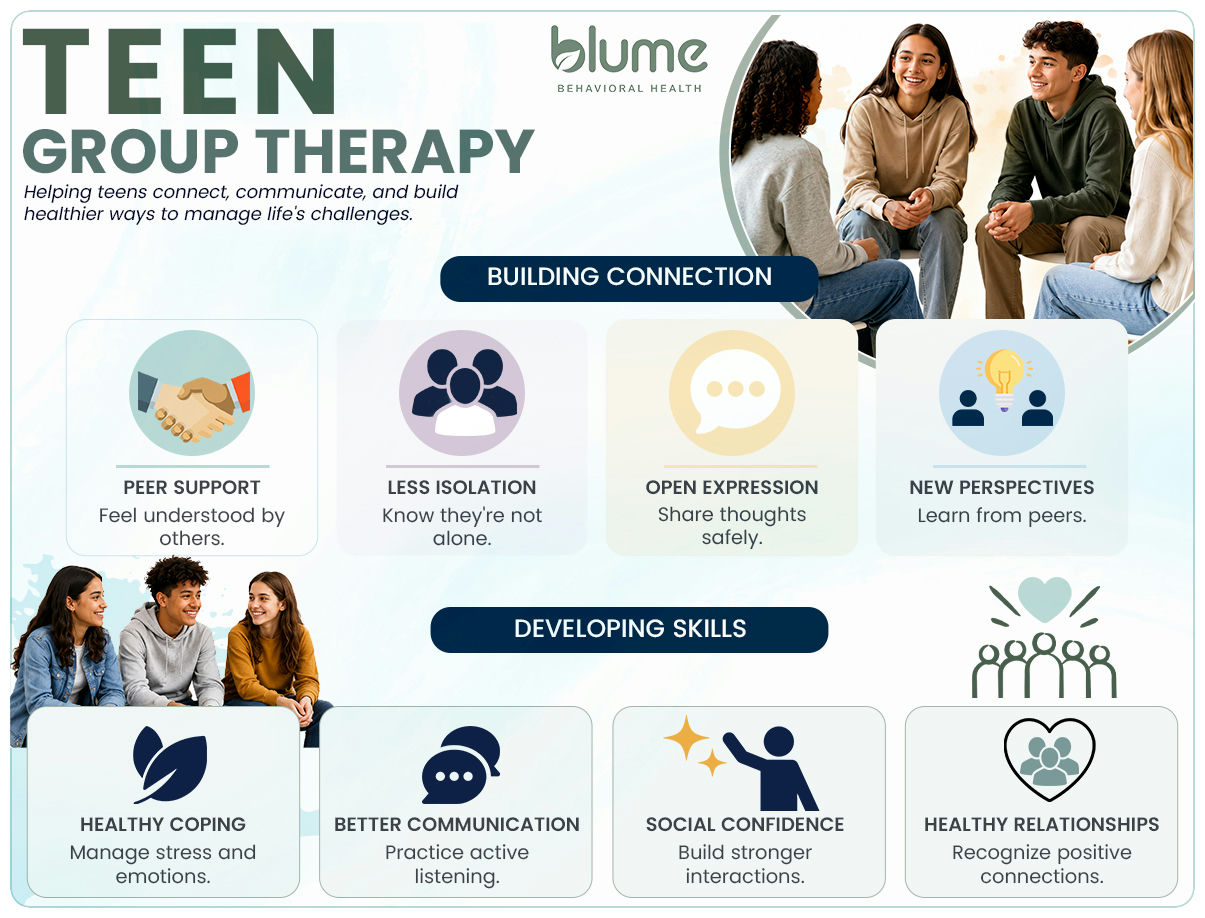
Group therapy is widely regarded as a highly reliable standard of care in outpatient settings. It is considered a highly effective modality, with outcomes often comparable to those of individual counseling for many teens.
Bullies, relationship issues, and peer pressure are among the many reasons why a teen may withdraw from family members and close friends. Group therapy can help them understand that they’re not alone while building a judgment-free environment to help examine their mental health issues with others.
Placement in group therapy is carefully considered to include teens who share common diagnoses, challenges, and experiences.
Group therapy for teens can address a wide range of emotional and behavioral struggles. Below are some of the most common conditions and experiences that bring adolescents into group settings.
Many teens carry the weight of difficult or frightening experiences. PTSD and trauma treatment in a group setting helps adolescents feel less alone, practice grounding skills, and begin to process what happened in a safe, structured environment. Teens dealing with trauma may also experience hypervigilance, a state of feeling constantly on edge or alert to danger, and group therapy can help them learn to regulate that response over time.
Some teens need support understanding unhealthy relationship patterns, including trauma bonding, which can develop after emotionally harmful or controlling relationships. Group therapy helps teens recognize these patterns, set healthier boundaries, and rebuild trust in safe relationships.
Losing someone or something important can feel overwhelming, and grief does not always follow a neat or predictable path. Grief support groups help teens name their emotions, feel heard by peers who understand loss, and learn that the stages of grief- denial, anger, bargaining, depression, and acceptance- are a reference point, not a fixed sequence every adolescent moves through in order. The five stages of grief can be a helpful framework, but teen grief is often non-linear, and group therapy honors that reality.
Group therapy can be especially effective for teens with social anxiety because the group itself becomes a supported practice environment. Rather than simply talking about social fears, teens have the opportunity to practice speaking up, listening, and connecting with peers in real time, all with a licensed therapist guiding the process and helping them manage anxious thoughts as they arise.
Many teens in group therapy struggle with rumination, the tendency to replay worries, regrets, or upsetting events over and over. Cognitive Behavioral Therapy (CBT) practiced in group settings directly targets these patterns, helping teens interrupt the cycle and develop healthier ways of thinking.
Group therapy can help teens who are highly sensitive to criticism or rejection, including those experiencing rejection sensitive dysphoria. In a group setting, teens can identify emotional triggers, slow down fast reactions, and practice more accurate interpretations of peer interactions, skills that carry over into school, friendships, and family life.
Disruptive mood dysregulation disorder is a condition marked by severe, frequent irritability and emotional outbursts that feel out of proportion to the situation. Group therapy can support teens with DMDD by providing structure, emotion regulation skills, and real-time therapist coaching around frustration and conflict.
Some teens struggle with trust, connection, or relationship patterns that may reflect a disorganized attachment style, often rooted in early experiences of inconsistency or fear. Group therapy offers consistent boundaries, predictable relationships, and repeated opportunities to practice trust and repair with peers and therapists in a safe setting.


Group therapy for teens is a structured form of therapy where adolescents meet with a licensed clinician and a small peer group to build coping skills, improve communication, and work through shared mental health challenges in a safe and supportive setting.
| Feature | Group Therapy | Individual Therapy |
| Focus | Shared goals, peer dynamics, social skill-building | Personalized goals, one-on-one exploration |
| Peer Interaction | Central to the treatment process | Not included |
| Skill Practice | Real-time practice with peers in session | Practiced individually or through role-play with therapist |
| Ideal Use Cases | Social anxiety, grief, trauma recovery support, emotional regulation, isolation | Complex trauma, highly individualized needs, early stabilization |
| Session Size | Typically 5–10 participants | One teen and one therapist |
Both formats are valuable, and many teens benefit from participating in group therapy alongside individual or family therapy as part of a broader care plan.
Group therapy is a useful clinical practice for teens with mental health issues because peer groups are a natural setting for young adults. Group settings provide a safe and supportive environment. Typically, groups are made up of young people who:
Group sessions of this type result in a complex communication system. An engaging environment is created in these sessions, providing a safe and interactive space where teens can connect, build coping skills, and receive emotional support to foster healing and personal growth.
The goal of group therapy is to promote maturity and independence through peer interactions and therapist guidance in a safe environment. Group therapy allows teens to discuss challenges and experiences from their daily lives. At the beginning of the group, communication usually radiates outward toward the group members from the formal group leader, the therapist. As time goes by, it becomes “circular,” with the participants mediating and showing interest in each other.
This change in communication indicates the group process. Group therapy settings typically have five to ten members to reinforce peer connections and allow the therapist to observe each member individually.
The therapist utilizes four core strategies to create a communicative environment that allows teens to grow. These strategies are:
These strategies help teens develop greater self-awareness, allowing them to better understand their emotions and support personal growth.
The exact way a session is conducted, as well as the activities, depends primarily on the group’s goals and the therapist’s style. Some might encourage a freer-flowing dialogue style in which each person participates as they see fit. Still, other therapists have a specific plan for each session that may include having members practice new skills with each other.
Common group therapy activities include:
There are different groups available to address different issues. In general, a small group of kids working through similar stressors is placed together. Groups are typically small, with about 8 to 10 participants, depending on the group’s nature. Group therapy can be tailored for school-aged children, teen girls, and teens struggling with various mental health challenges. In some cases, groups are organized by gender, but many focus on addressing a specific issue (e.g., social skills, anxiety). Examples of group therapy include:
Skills-based groups focus on teaching teens concrete tools for managing difficult emotions and situations. These groups are especially helpful for teens dealing with social anxiety, rejection sensitive dysphoria, DMDD (disruptive mood dysregulation disorder), or emotional reactivity. Sessions often draw on CBT frameworks, helping teens practice skills like identifying cognitive distortions, tolerating distress, and regulating intense feelings in the moment.
Process groups give teens space to talk through painful experiences with peers who understand. These groups are particularly valuable for adolescents working through trauma, trauma bonding, grief, or loss. Rather than following a structured curriculum, process groups allow conversation to unfold naturally, guided by a therapist who helps teens make sense of their feelings, recognize patterns, and support one another. Teens in these groups often find that hearing others’ experiences helps them understand that the stages of grief are not a straight line, and that healing is possible even when the path feels uncertain.
Expressive groups use creative modalities, such as art therapy, music, movement, or writing, to help teens communicate emotions that are difficult to put into words. Art therapy, in particular, gives adolescents a nonverbal outlet for processing trauma, grief, and identity-related struggles. These groups can be especially effective for teens who feel guarded in traditional talk therapy settings, offering a gentler entry point into emotional exploration and connection.
While group therapy offers many benefits, it can also present unique challenges for teens, such as navigating social anxiety, peer pressure, or interactions with authority figures. However, with support from a licensed therapist and encouragement from other group members, teens can learn to overcome these obstacles in a safe space.
It is also common for some teens to feel nervous, shut down, or become emotionally overwhelmed during early group sessions. For teens who tend to dissociate, a response where the mind disconnects from the present moment, often as a protective reaction to stress or trauma, therapists are trained to slow the pace, use grounding techniques, and help the teen re-engage safely without pressure. Participation is always paced to match each teen’s readiness, and no one is pushed to share before they feel safe doing so.
Group therapy provides a supportive environment where teens can practice self-expression, build confidence, and develop greater emotional awareness. By working through past experiences and discussing difficult emotions, group members can improve their relationships with family members and peers. As teens support one another and share their journeys, they create a sense of community that promotes healing and lasting change.
The future of group therapy is bright, with increasing recognition of its effectiveness in addressing mental health issues and supporting personal growth among teens. As more families seek out therapy support groups, group therapy is poised to become an even more popular and accessible option. Innovations such as creative activities, technology integration, and new therapeutic approaches are enhancing the group therapy experience, making it more engaging and relevant for today’s youth.
Emphasizing group dynamics, emotional awareness, and healthy coping strategies, group therapy equips teens with the skills they need to navigate the challenges of adolescence and beyond. As the field continues to evolve, group therapy will remain a vital resource for promoting emotional expression, resilience, and overall mental health in young people.
In the Redondo Beach, CA area, teen group therapy is available at Blume Behavioral Health. The goal at Blume is to leave nothing to chance when it comes to each teen’s care. Families can expect:
When a parent suspects their teen is struggling, taking action is a critical step. Blume Behavioral Health conducts a comprehensive assessment of each teen to create a personalized treatment plan and keeps families involved throughout the recovery process. If a teen is facing mental health challenges, the compassionate team at Blume Behavioral Health is here to help families navigate the path forward. Contact us today.
Group therapy for teens is a structured, therapist-led treatment where adolescents meet with a small peer group to build coping skills, improve communication, and work through shared mental health challenges in a safe and supportive setting.
Yes. Group therapy can help teens process trauma by reducing isolation, practicing grounding skills, and feeling understood by peers working through similar experiences. The approach is always paced carefully and tailored to each teen’s level of readiness and stability.
Group therapy can be very helpful for grieving teens because it gives them space to talk about loss, hear from others, and learn healthy ways to manage sadness, confusion, or withdrawal. Grief does not follow a fixed order, and group therapy honors that reality.
Yes. Group therapy supports teens with social anxiety by giving them guided opportunities to practice speaking up, relating to peers, and managing anxious thoughts in a structured environment, making the group itself part of the treatment.
If a teen begins to dissociate or feels emotionally overwhelmed, therapists slow the pace, use grounding techniques, and help the teen re-engage safely. Participation is always paced to match each teen’s comfort and readiness; no one is pushed to share before they feel safe.
Yes. Group therapy can help teens with rejection-sensitive dysphoria by identifying emotional triggers and practicing more accurate interpretations of social situations. For teens with disruptive mood dysregulation disorder (DMDD), structured skills groups provide real-time coaching around frustration tolerance and emotional regulation.
Families can contact Blume Behavioral Health to schedule a comprehensive assessment, discuss their teen’s needs, and determine whether group therapy or a higher level of care is the right fit.

Dr. Aneta Lotakov Prince is a board-certified psychiatrist with over 20 years of clinical experience treating adolescents and adults facing severe mental illness, co-occurring substance use disorders, and complex emotional and behavioral health challenges. Certified by the American Board of Psychiatry and Neurology, she holds an active DEA registration and California medical license. Dr. Prince’s patient-centered approach is rooted in compassion and driven by a dedication to improving quality of life and supporting long-term recovery. She remains deeply committed to empowering each individual she works with to build a life of purpose, connection, and resilience.